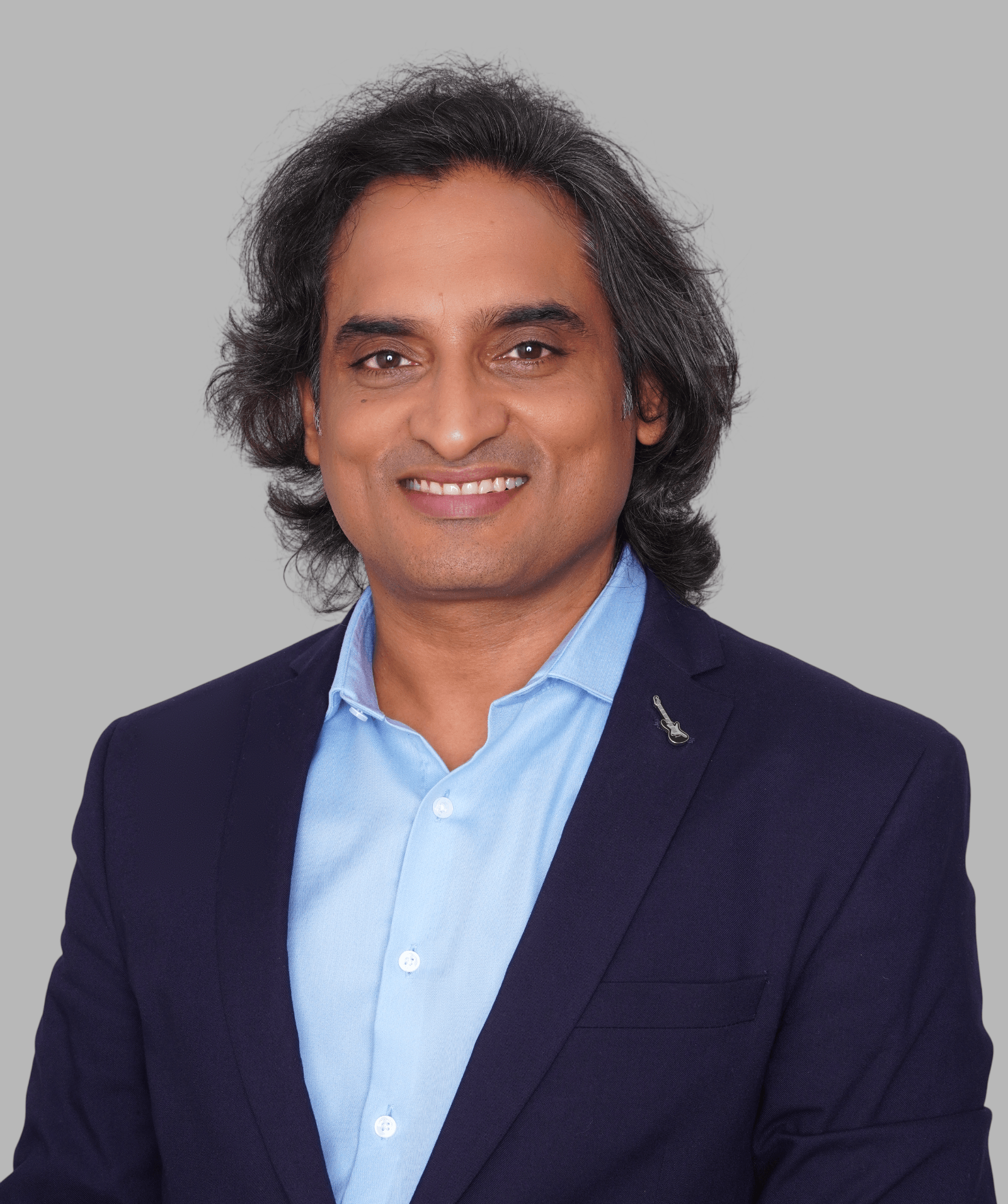
A Note From Our Founder
Dr. Ujjwal Rao
MD, PhD, MHA, MPhil, DMLE
CEO & Founder
The world does not lack experts. It lacks their reach.
Across three decades in clinical practice, hospital systems, and health technology, I’ve seen the same pattern repeat. We usually know which patient is being missed, which study design will hold, which submission survives review. What we cannot do is place that judgment everywhere it is needed, at a cost the world can bear. Expertise has always been the bottleneck. Not because it is absent, but because it cannot be in two places at once.
That constraint is now lifting.
Large language models reason across bodies of literature no individual could hold. Geospatial AI models reveal what routine disease surveillance cannot see. Protein structure prediction has earned a Nobel Prize. The tools now available are extraordinary.
But a tool is not an outcome. Between a foundation model and a tuberculosis case found in an unlisted settlement, between an embedding and an approved vaccine, sits a gap compute alone does not close. That gap is domain judgment: the way an epidemiologist reads a district, a regulatory scientist reads a reviewer’s question, a clinician forms a differential diagnosis.
Froncort exists to close that gap. The name is short for the frontal cortex, the region that plans, weighs consequence, and declines to act on impulse. Our work is to encode expert reasoning into systems that carry it faithfully, so that ingenuity now held by a few minds operates at population scale. In public health, that means finding disease where it actually is rather than where the program can conveniently look: tuberculosis first, then malaria, leprosy, cholera, and leptospirosis. In life-sciences, it means compressing the years and the cost between a promising treatment or diagnostic test and the patient waiting for it.
Our platforms are already in the field, built alongside national and state health programs, global health institutions, and technology partners. We are accelerating outcomes from research to regulatory to practice, at population scale.
What makes it possible is the people. Our team is a genuine confluence of experts: engineers who understand model architecture, clinicians and epidemiologists who understand disease, regulatory scientists who understand what a reviewer will accept. Our advantage is the crossover: engineers who understand the domain, and domain experts who drive engineering choices toward outcomes. That interdisciplinary honesty is our real intellectual property, and it is harder to assemble than any single technology.
We are a commercial enterprise built on a social mission. Durable solutions require durable institutions, and institutions are built on revenue and retained ownership. The same reasoning architecture that finds a missing tuberculosis patient carries a regulatory submission through review, so the markets that can pay for this work help fund the places that cannot. The cost of building these tools should not fall on the systems least able to carry it.
Technology has been waiting for problems worthy of it. These problems have been waiting far longer. Our work is to bring the two together, carefully and at scale, while the moment is ours. Expertise was never in short supply. Reach was. We intend to close that distance and deliver outcomes long overdue, by scaling human ingenuity.